What is Ad Personalization?
Ad personalization is the act of using customer insights to increase the relevancy of an ad to that specific person. These insights could be anything from demographic information to their specific interests, purchasing intent, and buying behavior.
Ad Personalization: A Complete Guide
If there’s one thing about online advertising that people hate, it’s seeing irrelevant ads.
Whether browsing social media, reading a news article, or watching videos on YouTube, seeing ads that don’t connect to your needs or lifestyle is annoying.
If you’re a brand that pays for advertising, you want to be sure that ad spend results in sales. So how do you reach the audiences who are most likely to buy?
As mentioned above, ad personalization uses customer insights to increase an ad’s relevance to a particular person. The insights available include basic demographic details, but they can also target specific interests, purchasing intent, and buying behavior.
Google, for example, considers an ad personalized when it uses previous or historical data to determine or influence the ads it shows users. That includes their previous search queries, site visits, demographics, location, etc.
Using data to create personalized marketing campaigns shows a commitment to understanding your customers and reaching them with appropriate messaging, no matter where they are in the sales process.
Effectiveness of Ad Personalization
The demand for personalized experiences is strong. According to a global survey of consumers, 62% will abandon loyalty to a brand if they don’t feel their experience is personalized.
Businesses benefit from delivering these personalized experiences. Twilio's 2024 State of Customer Engagement Report found that consumers spend an average of 54% more with brands that deliver personalized experiences, and 64% say they would leave a brand altogether if its experiences aren't personalized.
The pressure on brands to deliver is clear. But according to AdRoll + eTail’s Personalized Channel Activation in Retail & eCommerce report, only 6% of retail and eCommerce leaders have achieved fully integrated, automated personalization across channels. The majority (57%) describe themselves as still in a developing stage, personalizing in some channels but without the automation or unification needed to make it feel seamless to the customer.
Where Does Personalized Ad Data Come From?
Brands use cookies and tracking pixels to collect data about individuals' online behavior, recording what people search for, the websites they visit, and the products they view. Online stores use this information to remember visitor preferences and shopping history each time they return to the site, while advertising platforms use it to track performance and inform future targeting.
How companies source this info is changing. As old ways of tracking people across the web disappear and privacy rules get stricter, businesses are focusing on the information they collect themselves. This "first-party data" — things like your own website activity, email lists, and direct customer chats — is now the best way to keep marketing personal. It is more reliable, follows the rules better, and is easier to use than buying data from other companies.
Companies typically use these sources of information:
First-party behavioral data: This includes which pages people visit and what they do while browsing your site, tracked through your own tools.
Customer records: Information you already have, like purchase history and contact details.
Cross-device tracking: Tools that help you recognize when the same person is using a phone, a computer, or a smart TV, so you can provide a consistent experience while following privacy rules.
Outside research signals: Data showing when someone is searching for products like yours elsewhere on the web, helping you find potential customers before they even reach your site.
Focusing on the data you collect yourself helps you understand your customers better and build a more sustainable way to reach them in the long run.
Types of Ad Personalization
How do personalized ads work? Brands have plenty of options for creating unique marketing experiences for their customers. Whether you’re trying to create personalized display or video ads, the following types of personalization can ensure your marketing message reaches the appropriate audience.
Demographic personalization
Demographic personalization refers to ads that specifically cater to demographic information about the target audience. Common factors for demographic personalization include, but aren’t limited to:
Age
Gender
Income
Education level
Occupation
Marital status
Curious about what this kind of targeting looks like in real life? Consider a luxury car brand that targets older, affluent demographics. In another example, a brand that sells trendy fashion might focus ads on younger age groups.
Note that some ads, like those for employment, housing, credit, and other financial products, may have their targeting and personalization restricted. You cannot exclude audiences for those ads based on age, parental status, or gender.
Behavioral personalization
When you personalize ads for specific behaviors, you target that content toward users' actions online. That includes web browsing, social media activity, and even items they purchase from other websites. Personalized display ads or other types of content might use the following behavioral insights:
Web browsing: The websites a user visits, individual pages they view, and the amount of time they spend on each page can help infer interests and intentions.
Purchase history: Because past purchases can indicate user preferences, they enable personalized product recommendations for similar or complementary goods.
Click patterns: The ads people click reveal a lot about their content or product preferences.
Social media activity: Likes, shares, comments, and follows on social media sites like Facebook, TikTok, and Instagram can provide insight into users’ interests, opinions, and brand loyalties.
Need a personalized advertising example based on behavior? Consider an individual who looks at a selection of knives on Amazon but they don’t buy anything. The Amazon advertising network might show this user more ads for knives on other websites or social media.
Context-based personalization
Capturing customers at an exact moment is increasingly important in digital marketing. Your audience’s situation can change in an instant. Context-based personalization allows you to reach your customers when it makes sense. The following examples of context-level personalization allow you an even more granular amount of control over when your ads appear:
Location-based: You can tailor your ads for users based on geographical location. Imagine you own a popular bistro that is a neighborhood lunch destination. You can show lunch specials to users who are nearby around that time.
Time-based: You and your audience may have different priorities based on the time of day, week, month, or even year. Imagine a coffee shop that promotes its morning brew during the earliest part of the day or a streaming service that heavily showcases ads for new movie premieres in the evening or on the weekend.
Weather-based: Companies can adapt ads based on current weather conditions. Clothing retailers, for example, might advertise a raincoat or umbrella during a rainy forecast. On the other hand, sunny weather in a user’s location might prompt ads for shorts and tank tops.
Device-based: Even a user’s device can play a part in personalizing ads. Sites could display differently on mobile devices versus desktop computers. Advertisers may want to optimize for screen size or functionality.
Predictive personalization
One final data-driven approach to personalization uses algorithms and machine learning to predict customers’ future behavior, needs, and wants. This predictive personalization relies heavily on consumer data to then share tailored offers, products, or messages to those audiences across different channels and touchpoints. It is not manual segmentation, however. Machine learning and AI handle the legwork.
In practice, this kind of personalization involves the following process:
Data collection: Pull data about customers’ past behaviors, interactions, purchases, and any other relevant factors.
Data analysis: Algorithms and machine learning models analyze the data and identify patterns or trends.
Prediction: After analyzing the data, the system makes predictions about what a customer is likely to do, want, or need in the future.
Personalization: With predictions in hand, the model creates personalized content, offers, and recommendations for the customer.
Need an example? Imagine a customer who frequently buys a particular product type, such as shampoo formulated for curly hair. Predictive personalization might analyze that purchase and serve ads for other relevant products they’re likely interested in, like special conditioners.
Hyper-personalization
While predictive personalization looks at what groups of people might want based on history, hyper-personalization focuses entirely on the individual and what they are doing right now. It uses real-time information to make every ad feel like a personal, helpful suggestion rather than a generic sales pitch.
For example, instead of just showing you an ad for running shoes because you looked at them yesterday, hyper-personalization might show you an ad for waterproof trail markers because it’s currently raining in your city and you’re reading an article about local hiking paths.
Here is how this works in practice:
Real-time signals: The system notices immediate actions, like what you’re clicking on right now, how long you’ve been on a page, or even the device you’re using.
Automated ad adjustments: Instead of a person designing every single ad, the computer automatically swaps out headlines, images, and special offers to match what the viewer cares about most in that second.
Consistent experience: If you engage with a brand on your phone, the system remembers that when you later switch to your laptop or social media, so you don't keep seeing the same introductory ad over and over.
Smart decision-making: AI acts like a high-speed director, automatically choosing the exact right moment and place to show an ad so it’s most likely to be useful to you.
For marketing teams, this means they can provide a truly custom experience for every customer without having to manually build thousands of different ads themselves.
Retargeting
Retargeting is a way to stay in front of people who visited your site but didn't buy right away. Data from the Baymard Institute shows that about 70% of shoppers leave without finishing their purchase, often just to compare prices or do more research. Retargeting keeps your brand visible across social media and other sites, so you're top of mind when they're ready to buy.
For example, if a shopper looks at a specific pair of running shoes on your site but doesn't check out, you can show them an ad for those exact shoes on their social media feed to bring them back.
B2B Ad Personalization
B2B sales differ from consumer shopping because they involve a buying committee rather than a single person. A deal might involve an end-user, a manager, and a procurement officer, all with different priorities. Effective B2B personalization focuses on the company rather than just the individual. Instead of asking “What did this person browse?” you ask “What does this role at this company need to see right now?”
Common data inputs include:
Company details: Use industry, company size, and revenue to tailor the message (e.g., A manufacturing firm needs different solutions than a retail brand).
Research signals: Look for signs that a company is actively searching for your solution category.
Sales stage: Adjust your message based on where they are in your sales process (e.g., showing case studies to those in the evaluation stage vs. introductory info to new leads).
Engagement history: Use past interactions to guide the conversation.
Account-based marketing (ABM)
Account-based marketing (ABM) is a strategy where you treat your target companies as individual markets. Instead of a broad campaign, you focus your ads on a specific list of high-value businesses.
Personalization in ABM happens at three levels:
Account level: Tailor messaging to the business's specific challenges (e.g., 'Solutions for your industry').
Role level: Speak to the individual's priorities (e.g., Focus on security for a CTO; focus on ROI for a CFO).
Stage level: Align content with their status (e.g., Send educational guides to new prospects, but share client success stories with those close to signing).
How to Personalize Ads
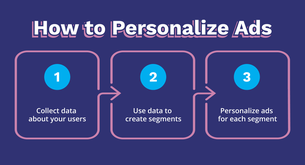
So you’re ready to personalize ads for your customers but are unsure how to get started. With the following process, you can build a segmented cross-channel marketing campaign .
1. Collect data about your users
Personalization doesn’t work without customer data. You can't effectively reach your target audiences if you don’t know anything about them. Leverage your resources to collect information.
Website analytics tools provide valuable behavioral insights, including how people get to your website, what they click on, and how much time they spend on each page. Cookies and tracking pixels allow you to track their activity across other sites. Even social media platforms can give you a detailed—if still relatively anonymous—glimpse of who your customers are and what interests them.
Of course, you can also just ask for details outright. Surveys and feedback forms let customers share personal information and what they think, and the right CRM gives you a place to store that information. Data unification helps you manage that information in one place and ensures the details therein are correct.
Customer data is a powerful tool. Be transparent about how and why you collect and use it to earn and maintain customers’ respect.
2. Use data to create segments
The data you collect and store allows you to build segments for every marketing campaign you’ll use in the future. Customer segmentation falls along many of the same lines as ad personalization. You can group customers by website and social media behaviors, interests, demographics, purchasing behavior, etc.
3. Create personalized ads for each segment
Once you have appropriate segments, you can create personalized ad content for each one. Each ad type and segment may require unique messaging, ad creative, coupons or offers, and even messaging timing. Once you know which types of marketing messaging resonate with each segment, you can create an appropriate media mix to reach them.
4 Tips for Leveraging Personalized Ads for Cross-Channel Campaigns
Personalization isn’t just for single campaigns. It’s a powerful way to maximize the impact of your cross-channel marketing efforts. Omnichannel personalization allows you to reach customers with highly specific, tailored messaging no matter what stage of the buying process or channels they choose to interact with you.
Many of the same principles that apply to personalizing a single ad campaign are relevant to multichannel campaigns. In fact, scaling your marketing efforts from one type of campaign to another is one of the best ways to reach multiple segments at once. Data-driven marketing can help you uncover which campaigns—and audiences—make the most sense for your brand, and tracking results will help you lower your marketing costs for the next campaign. Let’s walk through some of the best tips for cross-channel marketing efforts:
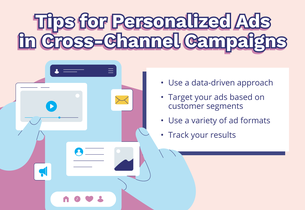
Use a data-driven approach
No matter how creative you are with your marketing strategy, using data to inform your decision-making is better than pure vibes. Customer data lets you see messaging preferences and know what kinds of CTAs, ad headlines, and images resonate the most with your customers.
Using A/B testing to change one element at a time allows you to experiment and gives you insights for future campaigns.
Target your ads based on customer segments
Your customers deserve better than a one-size-fits-all advertising approach. Tailor your ads to specific customer segments. To help with segmentation, consider using your buyer personas as a starting point. You can also use survey information to glean first-party insights and tap into the power of your CRM.
Use a variety of ad formats
The beauty of cross-channel campaigns is that you can use several ad formats to reach customers where they spend time online. Using personalized ads on social media allows you to put your products and message in front of potential customers on several platforms at once. Personalized video ads can run on platforms like Instagram and YouTube.
Track your results
You can run as many ads as you like, but tracking their performance allows you to know what’s working well and what isn’t. Instead of throwing money at campaigns with low open rates or CTR, use your budgets efficiently by closely watching each campaign and channel. If one is underperforming, cut back on spending or test alternate headlines or ad copy.
Get Started With Personalized Ads
With all the right data, you’re ready to begin your ad personalization efforts. Whether you’re sending out personalized emails or unique display or social ads, remember the following best practices:
Know where users are in the funnel, what pages or products they viewed on your site, and basic demographic data (Gender, Geography, Industry).
Decide on elements you want to personalize within your ads. For example, if the user visited a certain product page but did not convert, you might show them a display ad with that same product they considered buying.
Finalize the KPIs you’ll measure for campaign success. These could be converted sales, MQLs, additional visits to your site, or various other conversions.
When these elements are determined, you can move to the creative development phase of the campaign. In this step, you’ll work with writers, video editors, social media pros, and designers and/or web developers to create the ads you’ll run.
Once your ad creative and targeting are finalized, you’ll be ready to launch the campaign! If you need additional help with campaign optimization for your cross-channel marketing efforts, an all-in-one solution can streamline that process. AdRoll’s digital advertising platform enables you to deploy, measure, and re-optimize ad personalization campaigns.
FAQ
How do personalized ads work?
Personalized ads work by matching the right message to the right person based on their unique online behavior and interests. Instead of showing the same ad to everyone, platforms use data to tailor content to what a user is actually looking for or has shown interest in previously.
The process typically follows three steps:
Data collection: Tools like website pixels or CRM systems gather information on how a user interacts with your brand (e.g., pages visited, items viewed, or previous purchases).
Audience segmentation: This data is used to group users with similar behaviors or interests, such as "frequent visitors" or "cart abandoners."
Automated delivery: Ad platforms analyze these signals in real-time to serve relevant ads across different channels, ensuring the user sees content that reflects their current intent.
Why is personalized advertising important?
Personalized advertising allows you to tailor your marketing message to individual interests, needs, and preferences. It creates more engaging experiences for your customer. This leads to an improved customer experience, higher conversion rates, and boosted brand loyalty as customers feel seen.
How are personal ads created?
You can create personal ads for your audiences by using collected data to segment them appropriately by location, interests, demographics, and more. Personalization strategies can include showing different ad creative, headlines, promotions, and even campaign types.
How effective is personalized advertising?
Twilio's 2024 State of Customer Engagement Report found that 55% of consumers say they're willing to spend more money for a customized brand experience, and 48% say they've made a repeat purchase specifically because of the level of personalization they received.
What are the benefits of having a more personalized approach to advertising?
Adopting a personalized advertising approach enhances customer engagement as the ads resonate with your audiences and customers. Because happy customers tend to stick with a brand, it also aids in customer retention and increased conversions. Personalized ads are more effective and often lead to a better ROI. In short, personalized ads lead to more meaningful customer interactions, improved business outcomes, and stronger brand reputations.
What is B2B ad personalization?
B2B ad personalization is a way to tailor ads to businesses rather than individual shoppers. Since business purchases usually involve a team of people and more time to decide, these ads focus on the specific needs of a company and the roles of the people within it.
Key ways B2B personalization differs from consumer ads include:
Company focus: Ads change based on a business’s industry or size.
Role focus: Different team members see different messages, such as focusing on cost for a manager and technical features for a user.
ABM strategy: Account-Based Marketing uses this data to target a specific list of high-value companies with highly relevant content.
How is AI used in ad personalization?
AI handles the heavy lifting of personalization, working faster and at a much larger scale than a person ever could. Instead of manually creating hundreds of ad variations, AI constantly analyzes real-time data (like what a person is clicking, their device, and even the time of day) to automatically show them the most relevant ad. Not all ad platforms offer this capability, so it's worth confirming what level of AI-driven personalization your platform supports.
Think of it like having a personal shopper for every single visitor. While a human might struggle to update ads for thousands of customers individually, AI automatically determines which products to show based on what that person is most likely to care about right now. AdRoll's platform does this automatically through dynamic ads: you set your general goals, and the AI personalizes delivery by surfacing the most relevant products for each viewer in real time.