State of Digital Advertising Report
Advertising and marketing insights for digital marketers.
We analyzed data from tens of thousands of online businesses to help marketers understand overall digital advertising trends and recommend strategies to further improve marketing ROAS and ROI.
2026 Q3 Report Highlights for the Holiday Season
- From July 1 through September 8, display retargeting CPMs fell 29.1% from the same period in 2025, while display prospecting CPMs fell 45.0%. Compared with the comparable period in Q2, the declines were 40.2% and 25.5%, respectively.
- Over the same Q3-to-date window, ABM CPMs rose 4.4% year-over-year, the opposite direction of the other two channels, though they were still down 15.1% from the matched prior-quarter period. ABM, like retargeting, is priced against a narrow, named-account audience rather than the open market, so it's a weaker read on broad market pricing.
- The economic picture remained mixed. Inflation held steady and consumer sentiment weakened, but Bank of America card data showed spending per household remained solid in August as shoppers continued to favor value-oriented retailers.
- Lower Q3-to-date prospecting costs may give holiday marketers an early opportunity to build awareness before CPMs typically rise toward Black Friday and Cyber Monday. Marketers can use that lower-cost reach to build familiarity, then retarget interested shoppers with messages tied to their behavior.
Q3 CPM Trends Ahead of Peak Season
What Q3 CPM trends could mean for holiday advertisers
CPM, or cost per mille, is an advertising metric that measures the average cost of showing an ad one thousand times. CPM, similar to the cost of goods, is determined by supply and demand. In digital advertising, publishers serve as the suppliers through the websites and mobile apps that host and deliver ads to advertisers’ target audiences.
The selling and buying of digital ads on the web is typically conducted in an auction format handled programmatically by two types of platforms: the supply-side platform (SSP), representing publishers, and the demand-side platform (DSP), representing advertisers. Since the amount of available advertising space does not typically fluctuate as much as demand, changes in CPM are often driven by advertisers’ demand for ads.
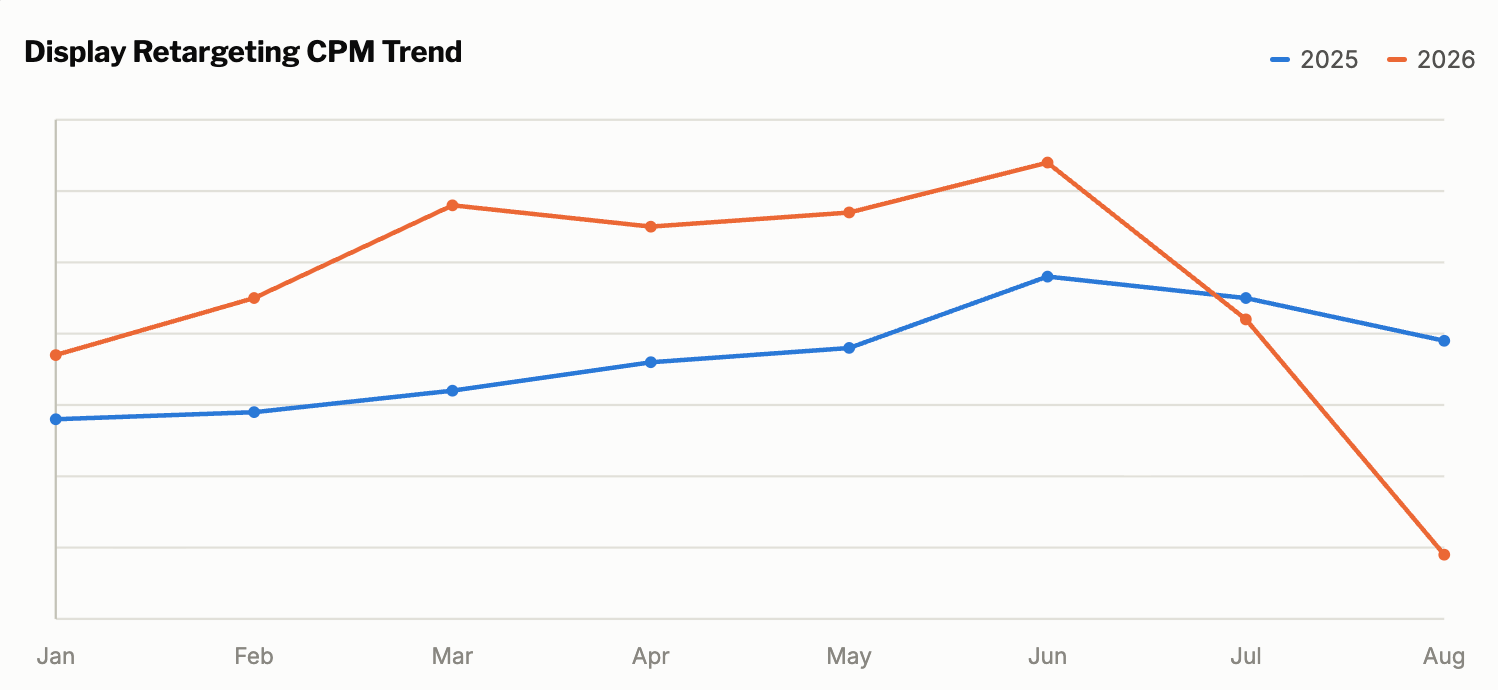
Display retargeting CPM trend
In Q3-to-date, display retargeting CPMs fell 29.1% from the same period in 2025 and 40.2% from the comparable Q2 period. Retargeting prices against a finite, already-engaged audience, so part of this move likely reflects audience availability as much as broader market pricing.
Display prospecting CPM trend
From July 1 through September 8, display prospecting CPMs fell 45.0% from the same period in 2025 and 25.5% from the comparable Q2 period. The smaller sequential decline shows that the pace of change slowed after the much larger year-over-year shift.

Account Based Marketing (ABM) CPM trend
Account-based marketing, also known as ABM, is a business-to-business marketing strategy that targets a specific group of high-value accounts through personalized advertising and sales outreach.
From July 1 through September 8, ABM CPMs rose 4.4% from the same period in 2025, though they fell 15.1% from the comparable Q2 period.

The Economic Outlook: What Cautious Consumers Mean for Holiday Advertisers
Inflation rate
The U.S. inflation rate held at 3.4% in August 2026, unchanged from July, as core inflation eased to 2.4% while energy prices rose 16.3% year-over-year.
While headline inflation held steady, faster monthly price growth and higher energy costs offer consumers little additional relief. Holiday advertisers should account for continued pressure on discretionary budgets and test how clearly their offers communicate value.

Consumer sentiment
The University of Michigan Index of Consumer Sentiment fell to 47.8 in September, down 7.5% from August and 13.2% from a year earlier. The survey reported sharp declines in expectations for personal finances and business conditions, while year-ahead inflation expectations rose from 4.0% to 4.6%.
The second consecutive monthly decline points to a more cautious start to the holiday season. Consumers may be more selective, increasing the importance of clear value and messages that reduce uncertainty around price and purchase decisions.

Consumer spending
U.S. consumer card spending remained solid in August 2026, with total credit and debit card spending per household rising 0.9% month-over-month and 4.5% year-over-year, according to the Bank of America Consumer Checkpoint report. Consumers continued to focus on value, with general merchandise and big-box retailers outperforming more traditional retailers during back-to-school shopping.

Lower Media Costs Meet More Selective Holiday Shoppers
Q3-to-date advertising data shows lower CPMs across display retargeting, and display prospecting. ABM CPM was essentially flat to slightly higher, likely reflecting its narrower, named-account audience rather than broader market conditions. Consumer sentiment has declined for two consecutive months and monthly inflation accelerated in August, while Bank of America card data showed household spending remained solid and value-oriented. While these datasets do not establish causation, read together, they show that holiday advertisers have cheaper access to audiences that are still spending but may respond more selectively to price and value.
Advertisers can use this period to build familiarity while prices remain relatively low. Concentrate spending on the channels the audience uses most, and carry a consistent message from awareness through conversion. Lower prices make reach easier to buy, but cautious consumers raise the bar for what qualifies as a strong, resonant message. Advertisers can use the cost advantage to test which value propositions earn attention before adding spend closer to peak season.
“With CPMs down across prospecting and retargeting, marketers have more room to test before holiday competition intensifies. Compare the cost of reaching each audience with the engagement, conversions, and revenue that follow. Use that full picture to reallocate budget toward the channels producing the strongest business results.”

Vibhor Kapoor CEO
Planning for the 2026 Holiday Season
Use lower prospecting costs to build awareness before peak season
From July 1 through September 8, display prospecting CPMs fell 45.0% from the same period in 2025, giving marketers more room to build familiarity before competition intensifies. CPMs typically rise through early Q4 and peak near Black Friday and Cyber Monday. Brands should explore leveraging lower-cost reach on the channels their audiences use most now, then shift toward conversion as shoppers move closer to purchase.
Turn early holiday interest into coordinated retargeting
In a recent study run by eTail and AdRoll of 100 senior retail and ecommerce leaders, coordinating messaging and timing across channels ranked as retailers’ top challenge when trying to retarget potential customers. For holiday cart recovery, this means advertisers need to act while intent is fresh. Use the products viewed or abandoned to shape the message, and stop targeting recent purchasers. Survey respondents repeatedly identified the first 24 to 48 hours after abandonment as a key window, so use a planned sequence to give each touchpoint a clear role and limit repetitive impressions.
Use ABM to stay visible through year-end planning
ABM helps B2B marketers stay visible with a focused set of high-value accounts across longer buying cycles. As year-end planning accelerates, coordinate advertising with sales outreach and use intent signals to adjust the message as account interest changes. After the season is over, evaluate results looking holistically at engagement, pipeline, and revenue.
Measure performance across the full holiday journey
Lower CPMs give marketers more room to test reach and messaging. Judge each campaign by the role it plays, using consistent tracking for reach, engagement, conversions, pipeline, revenue, and incremental return. A cross-channel view can also connect early awareness activity with outcomes that appear later in the season.
Off-Site Awareness Shapes the Holiday Shortlist
Holiday shoppers are increasingly using AI assistants, search, social, CTV, reviews, publisher content, and retail marketplaces before they visit a brand’s website. As a result, that website now often serves a later stage of consideration, when shoppers are checking price, availability, delivery timing, or whether a product matches what they found elsewhere.
For smaller brands, this shift makes awareness more commercially relevant. Google/Tracksuit found that growth in awareness produces measurable changes in search behavior and, ultimately, market share. During the holiday season, brand investment can influence which names shoppers remember, search for, and include in their shortlist once purchase intent rises.
Lower Q3-to-date prospecting CPMs give advertisers a chance to build recognition before holiday competition drives media prices higher. Marketers can look for the payoff in what shoppers do next, including branded searches, direct visits, product-page views, and stronger response from retargeting audiences.
Measure the handoff between awareness and active consideration. Track whether early exposure increases branded search and qualified site activity, then use first-party signals to continue the conversation after a shopper visits. This connects brand investment to observable behavior without reducing awareness to a last-click metric.
Retargeting Across the Multidirectional Holiday Journey
Retargeting remains a core conversion tool. In the eTail and AdRoll study, 99% of respondents said they were at least somewhat effective at re-engaging visitors, yet only 13% brought back more than 20% of cart abandoners. Broad confidence in retargeting has not translated into high cart-recovery rates.
First-party signals help marketers decide who should see what next. CRM or loyalty data was the most important retargeting signal for 67% of respondents, followed by on-site browsing behavior at 56% and cart abandonment at 55%. Those signals distinguish recent purchasers from product viewers and cart abandoners, allowing marketers to adjust the message, timing, and offer.
Consider a shopper who discovers a brand through a gift guide, CTV ad, or social post, views a product, and leaves. A follow-up message can feature that product or a useful incentive through display, social, or email. Once the shopper buys, suppress further conversion ads. Each interaction should pick up where the last one ended.
Retargeting can keep a brand relevant across the touchpoints that shape a holiday purchase. Better execution depends on tighter audience selection, timely follow-up, clear suppression rules, and coordinated channel roles.
FAQ
What is AdRoll?
AdRoll is a multi-channel advertising platform that helps mid-sized brands run full-funnel, AI-powered campaigns across channels. With tools for targeting, optimization, attribution, and account-based marketing through AdRoll ABM, teams drive results faster, all from one place.
What is the AdRoll State of Digital Advertising Report?
The AdRoll State of Digital Advertising Report offers marketers insights into business and advertising trends. The report is based on AdRoll’s performance statistics of more than 20,000 online businesses across finance, beauty and fashion, fitness, technology, travel, and other industries.
What are the key performance indicators (KPI) reported in the AdRoll State of Digital Advertising Report?
The AdRoll State of Digital Advertising Report provides the average CPM (cost-per-mille) trend on the following advertising media:
- Display Retargeting
- Display Prospecting
- Account Based Marketing
How often will the information in the AdRoll State of Digital Advertising Report be updated?
The information in the AdRoll State of Digital Advertising Report will be updated on a quarterly basis.
Stay up to date on data
Sign up for our monthly newsletter to get the latest industry news + tips and tricks for multiplying ROI.